
More than three decades ago, I had the opportunity to view the immersive Cités-Cinés exhibition in Paris. Within a variety of city-themed scenes, such as a garage, rooftop, and jail cell, visitors could watch short clips from classic movies that had been filmed in similar settings. There was no text, only sound tracks played through personal infrared headsets. It was an amazing experience that reinforced my interest in immersion as a means to enhance visitor engagement. It became a major influence on creation of Science City at Union Station in Kansas City. Today, immersion seems to have become a fad with the opening of many new “immersive” attractions and overuse of the term for promotion.
Immersion can take very different forms, ranging from virtual environments to “real” designed settings. Virtual reality experiences immerse viewers in computer-generated simulated 3-D environments, typically explored with individual headsets. Many applications, such as exploring the metaverse, can in principle be accessed anywhere, rather than through one-of-a-kind visitor experiences. Augmented reality and mixed reality layer digital information onto real-world settings and can be used by museums to enhance interpretation. These more personal approaches are not the focus of this post.

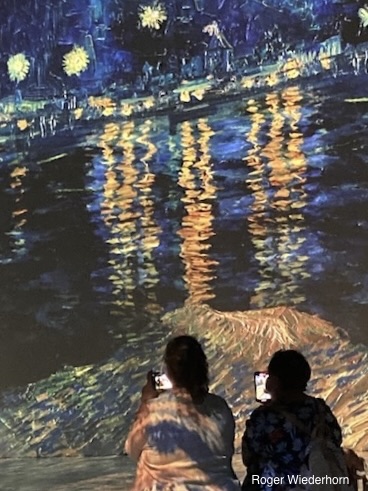
Projection technologies have been used to create immersive theater experiences for decades. Examples include large-format films, planetarium shows, and 3-D movies. The recent advent of high-resolution digital projection technology using lasers as the light source has led to an explosion of new types of commercial offerings. One form, immersive art, dubbed “artainment” by some, surrounds visitors with large-scale images based on works of well-known painters such as Vincent Van Gogh. Others immerse visitors in projection-mapped imagery created by contemporary media artists and designers, like productions by Artechouse. Some are based on immersive scenes taken from nature, such as those created by Tokyo-based teamLab. These types of experiences can employ motion tracking technologies that enable visitor interaction.
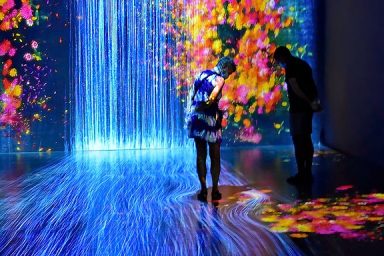
A further level of immersive “reality” can be created using constructed or actual physical environments that portray historical, present-day, or imaginary settings. This approach has long been taken by theme parks and living history sites, for example. Similarly, it has been applied by natural history museums and zoos with walk-through environments, and science museums with exhibitions such as a re-created coal mine or programs like Challenger Learning Center space flights. A recent innovation is the orchestrated creation by groups of local artists of connected immersive settings, such as the imaginative Meow Wolf installations.

Although highly variable, these immersive approaches share certain features. While engaged, participants are willing to accept and feel part of an alternate reality even though they know it is fabricated. The psychological effect has been described as “willing suspension of disbelief.” Various factors influence the extent of immersion, including setting verisimilitude, multi-sensory involvement, interactivity, narrative engagement, cultural resonance, social interaction, and personal interest.
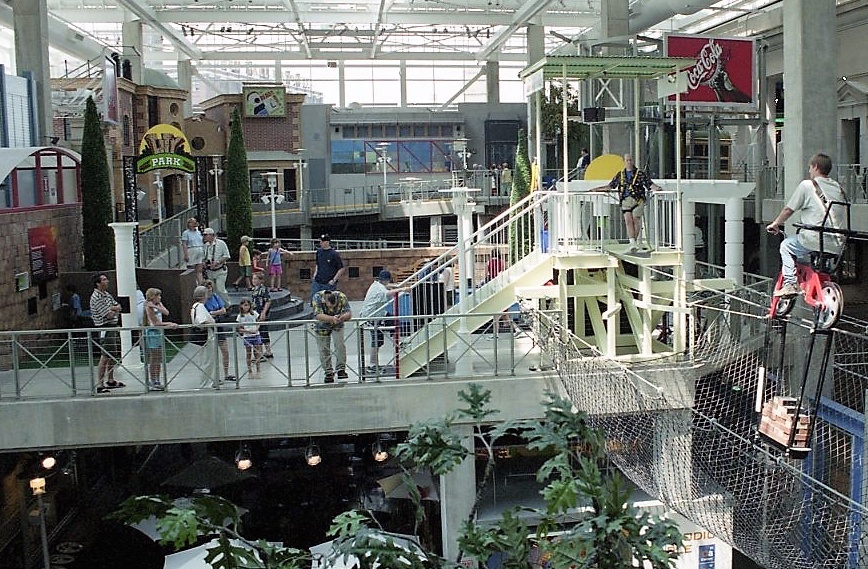
Inspired by Cité-Ciné, Science City was designed to enhance visitor emotional engagement and motivation, key facilitators of informal learning, by means of interactive “adventures” within immersive contextual settings. For example, visitors could become detective “trainees” in the crime lab or explore optical and auditory illusions in the Mr. E (“mystery”) Hotel. Great attention was placed on consistency of narrative, propping, programming, and overall alignment to maintain immersion during an average visitor stay time of three hours upon opening.
Part 2 will address several potential ways that museums can make use of immersive approaches to further their educational mission.
Related Articles
Ucko, D. A. (1991). Science City: A new model for science centers. ASTC Newsletter, 19(5), 13.
Ucko, D. A. (n.d.). Science City at Union Station: A new model for recreational learning.
Resources
Is Immersion Just a Fad? [Pt 2]
Blooloop (visitor attraction news)
1 thought on “Is Immersion Just a Fad? [Part 1]”