

In early 2021, there were as many as five competing “immersive” Van Gogh shows in the U.S. One producer has since declared bankruptcy. Multiple attractions continue to compete for visitors in some cities, and there may be a shakeout in oversaturated markets. Nevertheless, new immersive venues and programs continue to be developed, most as commercial ventures with high ticket prices. The Google search trend line below shows a spike in use of the search term “immersive” in March 2021, followed by a decline that started in mid-2023.

The novelty and initial audience thrill may be wearing off, especially for those attractions that lack strong narrative or content beyond the experience itself. It remains to be seen to what extent these venues, both those featuring projected works from well-known artists and those generated de novo
by artists, designers and fabricators, draw visitors away from traditional museums or stimulate interest among new audiences.
These commercial attractions may well be raising public expectations about the museum visitor experience, which is typically not immersive in the sense described in Part 1. The rationale for adapting appropriately applied immersive techniques goes beyond keeping up with other venues, however. Put simply, immersion offers museums the potential to enhance visitor engagement and motivation in support of their educational mission.
Here are some possible approaches for developing meaningful immersive learning environments:
–Dedicate a space for changing immersive experiences using an infrastructure of multiple high-resolution video projectors to provide a reprogrammable digital content platform. Although the initial equipment expense would be significant, it could be amortized over multiple shows. Programs developed for use in similar spaces could be shared among participating museums by means of a national or international network, like the one connecting Culturespaces’ Hall des Lumières digital art centers. Sharing a hard drive or downloading files would be less costly than shipping a traditional exhibition. Carrying out this approach would implement a form of the “exhibition transformer” concept proposed by the late John Jacobsen more than a decade ago for changing visitor experiences, adding to the existing formats of traveling exhibitions and giant screen films.

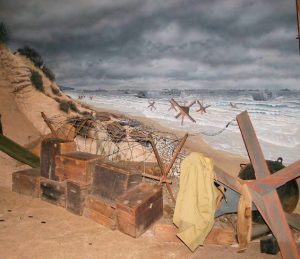
–Create “hybrid” permanent or temporary exhibitions by embedding artifacts and interactive activities within contextual stage sets or high-resolution projected imagery. Historical recreations take this type of approach, such as the East Texas Oil Museum street scene at the top and the 1st Division Museum Normandy Beach scene below, which is revealed after walking out of a theater that replicates a D-Day landing craft. That strategy could be applied initially on a modest scale for experimenting with immersive techniques to explore their feasibility and evaluate audience impact. For example, a gallery in an art museum could become an artist’s studio, giving visitors insight into the process and setting in which the artist might have worked. Instead of traditional labels and text panels, graphics and props can convey content, such as a newspaper from the era or an invoice for paints; staff could role play to enhance engagement and provide further interpretation. Similarly, a science exhibition on forensics could be embedded within an authentic-looking crime lab setting in which visitors can solve a crime.
–New or renewing institutions could consider adopting more ambitious large-scale fabricated or media-based contextual theming throughout the facility, analogous to the design of Science City at Union Station. Media can be integrated with architectural design as in Sphere, a music and entertainment arena in Las Vegas whose exterior and interior walls are covered with computer-controlled high-resolution LED video panels (which currently cost much more than digital laser projectors). Attention to detail consistent with the theme is key to maintaining visitor immersion.
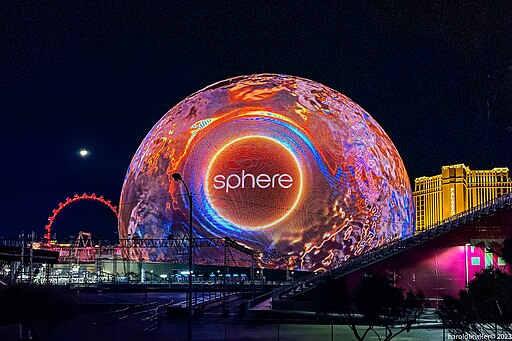
(Harold Litwiler, Orcutt/Istanbul USA
CC-BY-SA-2.0)
–Develop or deliver existing content-based immersive group programs within appropriately themed spaces, which could be historic, present-day, futuristic, or imaginary. Some examples of many possible settings are an attic, cabin, cavern, dig site, factory, kitchen, Mars outpost, studio, and workshop. If program implementation is faithful to the theme, immersion can enhance its impact. Challenger Learning Center interactive “flights” can seem so real that middle school students may think that they actually carried out a space mission.
In applying these approaches, museums have the opportunity to learn from the growing number of immersive attractions, adapting those practices that are most relevant to their own institution and its educational mission. By adopting whole-body multi-sensory immersive formats, museums can create memorable experiences that have the potential to increase emotional engagement and further visitor learning.
While doing so, it would be valuable to conduct evaluation and research studies that add to the literature, which tends to focus on applications of virtual reality. Depending on the resources available, they could be carried out by staff, contractors, or university partners. The overarching aim is to help determine how informal learning can best be fostered through immersive experiences. Possible guiding questions might be:
- How can the extent of immersion most effectively be measured?
- What minimum preconditions are necessary to achieve “immersion”? Do they seem contextual or universal?
- Which immersive approaches appear to be most effective in particular contexts and settings?
- Are their instances where immersion appears counter productive?
Immersion today may be a buzz-word and have characteristics of a fad. However, its popularity demonstrates the ability of this approach to capture public interest. Although no panacea, it offers the potential to play a significant role in informal learning if appropriately and creatively applied.
Related Article
Jacobsen, J. W., Wisne, J., MacGillivray, S. & West, R. W. (2014). A new, additional format for changing visitor experiences. Informal Learning Rev., 125, 13-16.
Resources
Is Immersion Just a Fad? [Part 1]
1 thought on “Is Immersion Just a Fad? [Pt 2]”